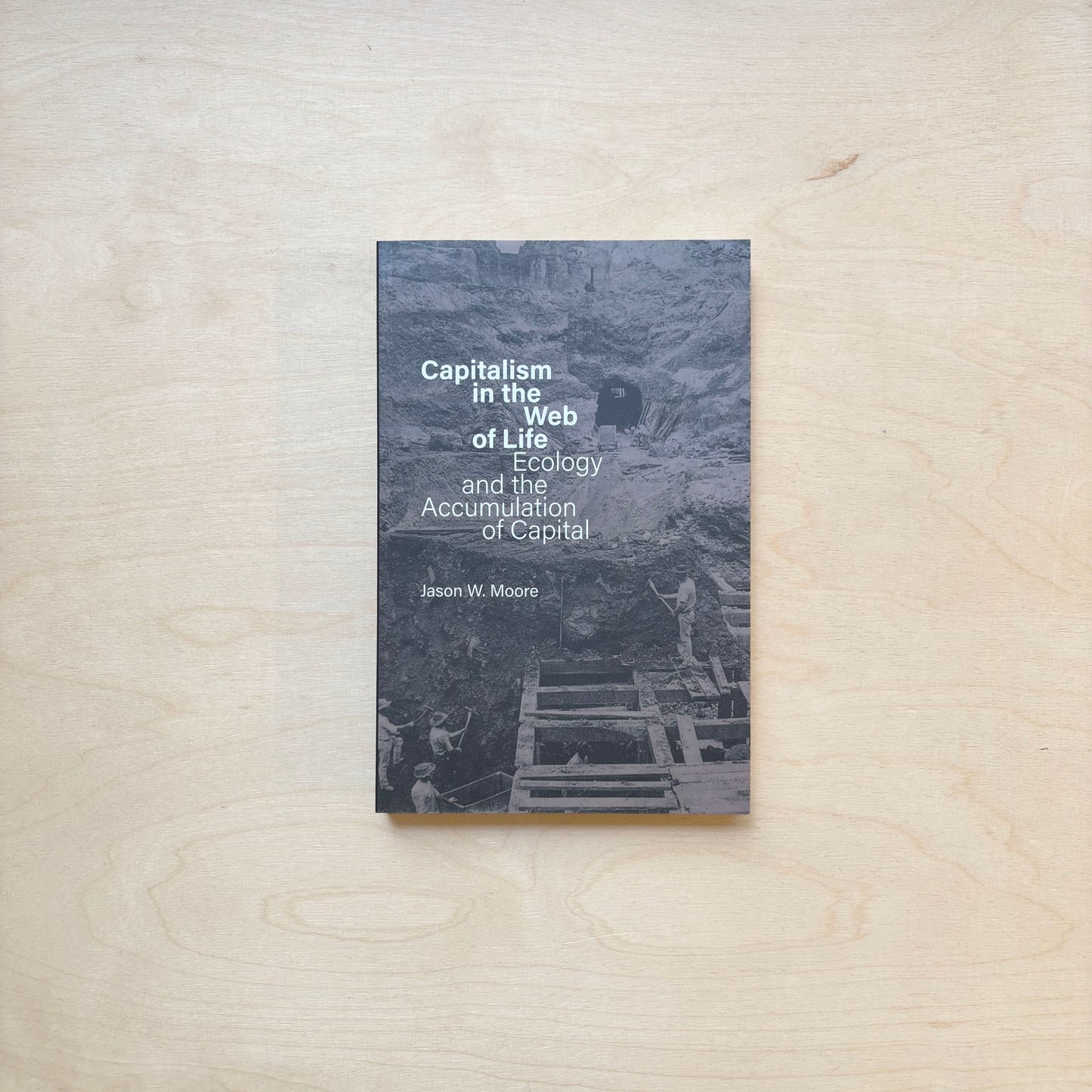
Capitalism in the Web of Life: Ecology and the Accumulation of Capital (new edition)
Capitalism in the Web of Life: Ecology and the Accumulation of Capital (new edition)
Jason W. Moore
Verso Books
2025
9781804298329Softcover
23,5 x 15 x 2,5 cm
352 pages
Couldn't load pickup availability
The relationship between capital and ecology in the longue durée
Finance. Climate. Food. Class. How are the crises—and politics—of the twenty-first century connected? In Capitalism in the Web of Life, Jason W. Moore argues that the sources of today’s global turbulence have a common cause: capitalism as a way of organizing planetary life. Drawing on environmentalist, feminist, and Marxist thought, Moore offers a groundbreaking synthesis: capitalism as a “world-ecology” of power, profit, and life.
Praise:
"If nothing else, the climate crisis demonstrates that the history of capitalism is a thoroughly ‘environmental’ one. This energizing book proposes an inventive framework for making sense of that past, and for orienting ourselves as we get down to the business of changing the future." - Naomi Klein
"The achievement of Moore’s book is to move past a metaphysical concept of nature towards an historical one ... Such a rich historical understanding of world-ecological regimes is going to be of vital importance." - McKenzie Wark
"Nature is not a foundation, container, or resource; it is us. As Moore tells us, we must live history as if nature matters." - Donna Haraway
"If you’re interested in cutting-edge ecological thinking, Capitalism in the Web of Life is a must-read. Moore’s scope is vast, and few could pull off as ambitious an analytical achievement as he has here. There’s enough scholarship, wit and insight to leave your copy with margin notes on every page, and ideas for a lifetime. A landmark book." - Raj Patel
"Moore’s radical and rigorous work is, and richly deserves to be, agenda-setting." - China Miéville
"Not only does Moore provide an exceptionally powerful sense of the dystopian impact of capitalism … he also reveals a compelling dialectical grasp not just of how it might have to come to an end, but why it would be deplorable even if there were no limits to its continuing." - Kate Soper