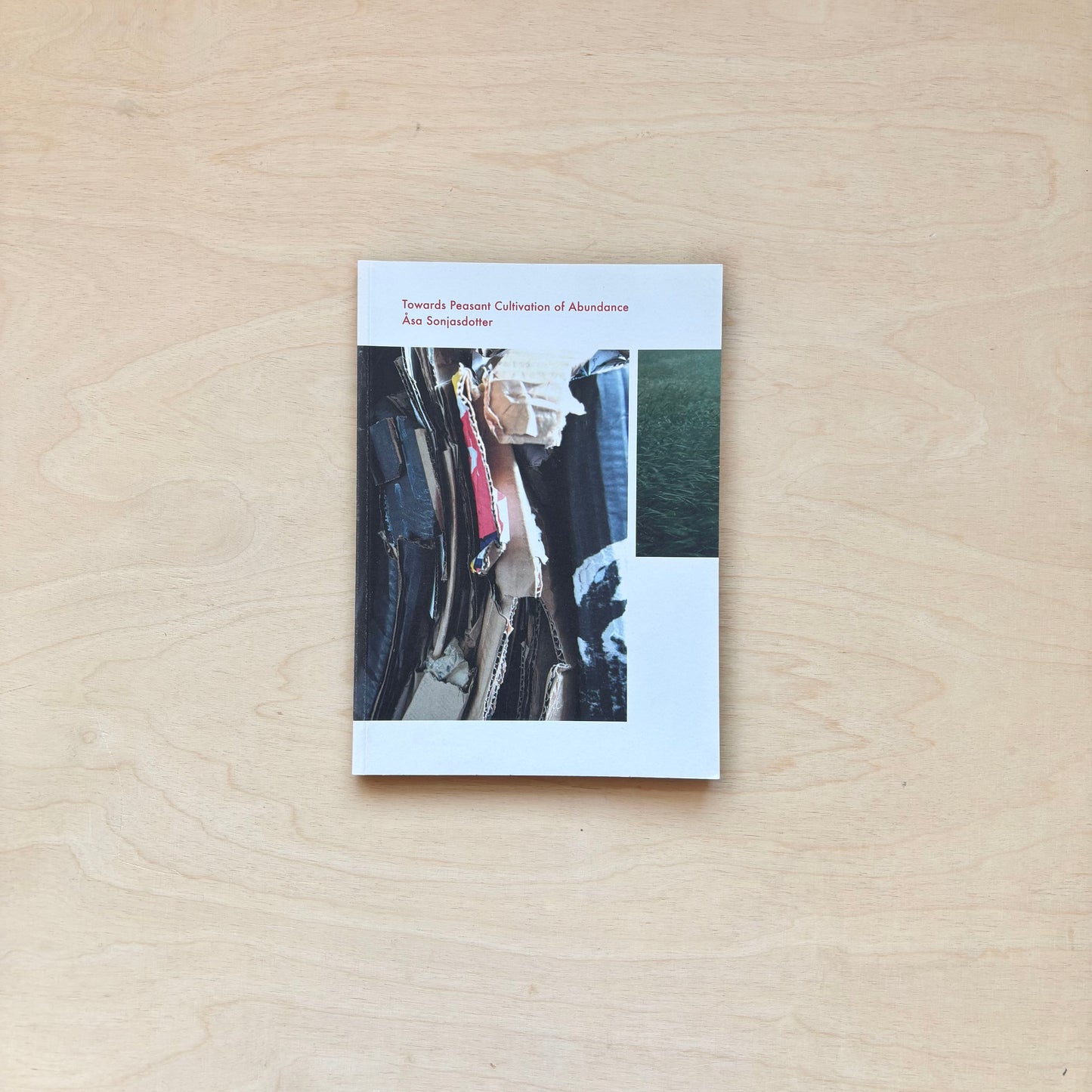
Towards Peasant Cultivation of Abundance
Towards Peasant Cultivation of Abundance
Åsa Sonjasdotter
2025
9789180697033Softcover
24 x 17 x 1 cm
143 pages
Regular price
18,00 €
Regular price
Sale price
18,00 €
Unit price
per
Tax included.
Couldn't load pickup availability
Towards Peasant Cultivation of Abundance investigates modes of relations in peasant crop cultivation. The author, visual artist and researcher Åsa Sonjasdotter, follows traces of such practices through artistic means, seeking to construct a conceptual framework that diverges from the capitalist paradigm of cultivation. In place of the paradoxical focus on both unlimited growth (of profit) and (artificial) scarcity, Sonjasdotter proposes that peasant crop cultivation can provide a model for 'relations of abundance' - that is, the social relations that proceed through and from peasant cultivation practices in contrast to industrial monoculture farming.
The research begins with The Order of Potatoes (2009–ongoing), an artistic work based on the recultivation of peasant-bred crops in the highly industrialized farming landscapes of southern Scandinavia. This artistic undertaking requires a reworking of the concepts through which these practices can be reinstated and renewed. The project employs a twofold approach of (1) recultivation and (2) tracing back through textual, visual, and material archives, including the cultivars themselves, understood as having an archival potential.
This methodological framework is articulated with reference to a range of ways of working, including microhistorical survey (Carlo Ginsburg), a historiography of rewinding (Ariella Azoulay), and a strategy of 'intimate reading' (Lisa Lowe). Building on the conceptual and practical issues raised by The Order of Potatoes, subsequent artistic works within the framework of this research include Tracing Agricultural Memory – Refiguring Practice and Cultivating Stories – Cultivating Abundance.
The work of retracing attends to, assembles, and gives narrative form to both lost and remaining signs of peasant cultivation, such as tools, marks in the landscape, the crops themselves, and the in-kind taxation records of the authorities. A close reading reveals how soil extraction, mainly through taxation, culminated in the collapse of peasant cultivation systems in the late 1700s in the regions studied. An important consideration for this research is the neglect of the peasantry as an agent in accounts of modern knowledge production and modern political projects. It also provides an overview of the theoretical positions that explain why peasants have been relegated to the past in these realms. The social and sensory aspects of both peasant and modern relations of cultivation are elaborated by contrasting their respective techniques and priorities within plant breeding. The two modes of relationship – peasant and modern capitalist – are brought into dialogue through the technique of assemblage. The aim of this research is to provide a means to imagine and implement cultivation practices that move away from the capitalist paradigm of growth and scarcity and generate relations of abundance.
The research begins with The Order of Potatoes (2009–ongoing), an artistic work based on the recultivation of peasant-bred crops in the highly industrialized farming landscapes of southern Scandinavia. This artistic undertaking requires a reworking of the concepts through which these practices can be reinstated and renewed. The project employs a twofold approach of (1) recultivation and (2) tracing back through textual, visual, and material archives, including the cultivars themselves, understood as having an archival potential.
This methodological framework is articulated with reference to a range of ways of working, including microhistorical survey (Carlo Ginsburg), a historiography of rewinding (Ariella Azoulay), and a strategy of 'intimate reading' (Lisa Lowe). Building on the conceptual and practical issues raised by The Order of Potatoes, subsequent artistic works within the framework of this research include Tracing Agricultural Memory – Refiguring Practice and Cultivating Stories – Cultivating Abundance.
The work of retracing attends to, assembles, and gives narrative form to both lost and remaining signs of peasant cultivation, such as tools, marks in the landscape, the crops themselves, and the in-kind taxation records of the authorities. A close reading reveals how soil extraction, mainly through taxation, culminated in the collapse of peasant cultivation systems in the late 1700s in the regions studied. An important consideration for this research is the neglect of the peasantry as an agent in accounts of modern knowledge production and modern political projects. It also provides an overview of the theoretical positions that explain why peasants have been relegated to the past in these realms. The social and sensory aspects of both peasant and modern relations of cultivation are elaborated by contrasting their respective techniques and priorities within plant breeding. The two modes of relationship – peasant and modern capitalist – are brought into dialogue through the technique of assemblage. The aim of this research is to provide a means to imagine and implement cultivation practices that move away from the capitalist paradigm of growth and scarcity and generate relations of abundance.