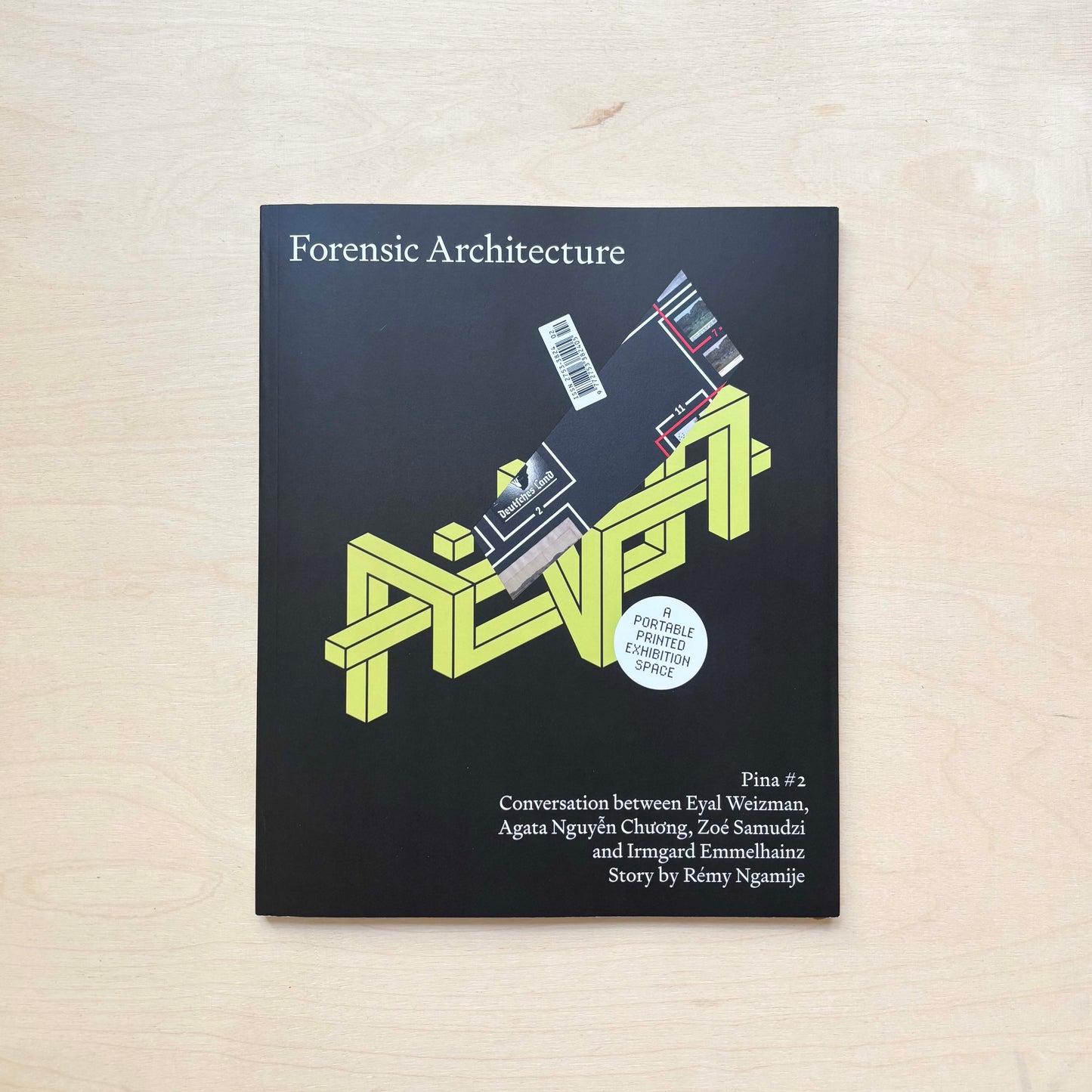
Pina Issue 2: Forensic Architecture & Edgar Calel
Pina Issue 2: Forensic Architecture & Edgar Calel
Catalina Imizcoz (ed.)
2025
Softcover
29 x 24 x 1 cm
pages
Verfügbarkeit für Abholungen konnte nicht geladen werden
In this issue of Pina:
Exhibitions by Edgar Calel and Forensic Architecture, conversations with Lisette Lagnado and between Eyal Weizman, Agata Nguyen Chuong, Zoé Samudzi and Irmgard Emmelhainz, and short stories by Portia Subran and Rémy Ngamije.
~ ~ ~ ~ ~
Forensic Architecture presents ‘A Counter-Archive of the Ovaherero and Nama Genocide’, a powerful investigation into the early 20th-century genocide committed by German colonial powers in today’s Namibia. Drawing on years of archival research and spatial analysis, the exhibition traces the lasting impact of colonial violence in three parts: from the ideological roots of racialised imperialism, to the design of the concentration camp, to the ongoing environmental degradation and dispossession affecting Indigenous communities today.
In doing so, Forensic Architecture joins historians in positioning the genocidal infrastructure developed by colonial powers in ‘German Southwest Africa’ as an antecedent to the Holocaust perpetrated by the Nazis. ‘A Counter-Archive’ invites readers into an urgently relevant discussion on the broader origins of genocide within its present-day global manifestations – namely in Palestine. It also contributes to a crucial and ongoing claim for land restitution and reparations in Namibia.
It takes a non-linear approach to the archive, zooming in on specific objects and documents before zooming out to show their wider context – inviting multiple interpretations that acknowledge the complexity of how history is constructed. The project also reflects critically on its own use of colonial-era materials, asking what it means to work with them and the violence from which they originated.
These ideas are further explored in a conversation between Eyal Weizman, Agata Nguyen Chuong, Irmgard Emmelhainz and Zoé Samudzi. The exhibition is also accompanied by a new short story, ‘Breaking Even’, by Rwandan-born, Namibia based writer Rémy Ngamije. He is the founder of Doek!, an independent organisation in Namibia supporting the literary arts. The story pauses at an intimate moment between a father and his son, meditating on the trajectory of a life as it is shaped not just by the past but more so by the indeterminacy of the future.
~ ~ ~ ~ ~
Edgar Calel’s ‘Dreams and memories dazzle through the flickering of fireflies’ is an exploration of dreams, memory and everyday life within his multi-generational family home in Comalapa, Guatemala. Each morning, dreams are shared among family members, as a practical and poetical way to sense the energy of the day ahead. Concrete business plans and reminders to cook certain dishes emerge from these retellings: a ritual so entwined in the architecture of their every day, that, even when apart, they recount their visions through shared voice notes.
Calel records these dreams by etching them onto the smoke-stained walls of the home, which bear the sediment of their hearth, transforming the transient into a living archive. These drawings are transposed onto Pina’s pages, interspersed with Kaqchikel poetry, family Polaroid photographs and notes – documenting the subtle textures that feed the artist’s and his family’s dreams. As a registry of the most fragile of images, Calel’s exhibition is an invitation to use our sense of touch to see the fleetingness and potency of dreams, poetry and intimacy.
A conversation between curator Lisette Lagnado and Calel offers deeper insight into these practices, connecting to anecdotes in the artist’s biography and inviting a cosmological reading. ‘Dreams and memories dazzle through the flickering of fireflies’ is accompanied by a newly commissioned short story by Trinidadian writer Portia Subran, whose story ‘A Gathering of Seeds’ uses xenofiction to journey through generations, prompting reflection on how dreams can serve as a vessel for the spiritual and bodily nourishment necessary for survival.
~ ~ ~ ~ ~
About:
Pina is a printed, portable exhibition space. We function as a commissioning platform, collaborating with artists to create exhibitions existing solely within the pages of a magazine.
The magazine’s name derives from pinax – a flat, painted board or tablet – and the root of pinacoteca, meaning a home for images. The commonality with a white cube gallery lies in the encounter, though this one is portable.
Each commission spans 60 pages, offering artists the space to construct immersive worlds, which audiences can explore as they would any other exhibition. Each issue pairs its exhibitions-in-print with bespoke short stories, inviting two writers to respond to the exhibition layouts through fiction. Straddling both literary and contemporary arts publishing, Pina offers an intimate and imagination-driven exhibition visit.
The all-women team includes researcher Catalina Imizcoz (Founder and Editor), poet and radio-host Bitsy Knox (Deputy Editor) and cultural producer Lucila de Arizmendi (Producer).
Designed as a two-covered, soft-back publication by Graphic Thought Facility – in partnership with founders Huw Morgan and Paul Neale – Pina is produced in London.