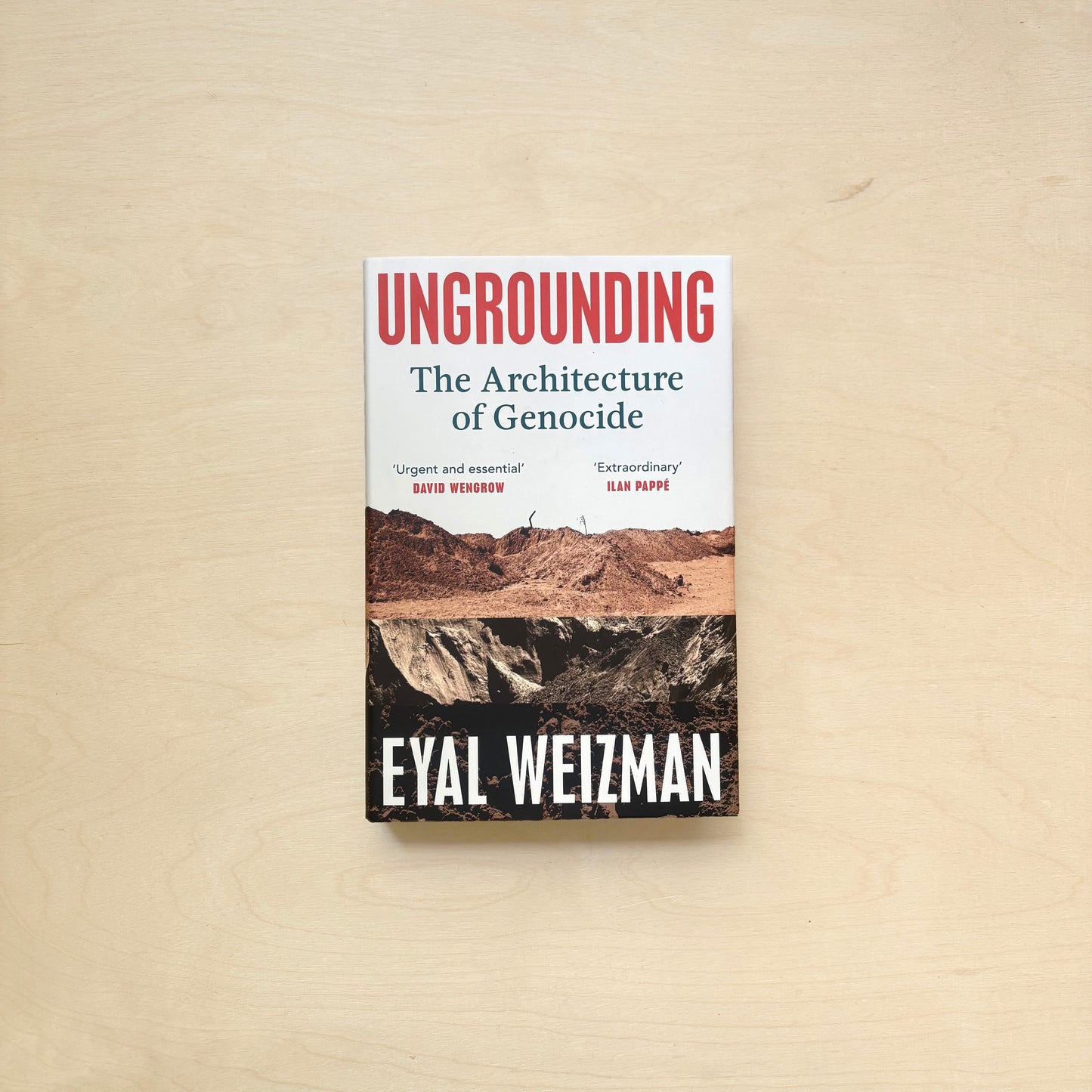
Ungrounding - The Architecture of Genocide
Ungrounding - The Architecture of Genocide
Eyal Weizman
Fern Press / Penguin
2026
9781911717331Hardcover
24 x 17 x 4 cm
416 pages
Verfügbarkeit für Abholungen konnte nicht geladen werden
Eyal Weizman is one of the world’s leading experts on the relationship between violence, conflict and the environment, both built and natural. As director of the organisation Forensic Architecture, he and his team of interdisciplinary researchers document acts of state crimes and human rights violations around the world. Since 2023, the group has worked to produce evidence for the International Court of Justice’s genocide case against Israel.
In this revelatory new project, Weizman draws on that research to bring us on an eye-opening journey across time and into the 'deep cartography' of the area extending from Gaza’s subterranean tunnels through to its militarised topography, its unique soil, settlements and barriers. He catalogues, in unflinching and forensic detail, the Israeli campaigns of violence and displacement that have reshaped the region in an effort to make Gaza and its surrounding areas unliveable. Taking us through the broader geographic and historical context, from the Nakba in 1948 to the present day, Ungrounding establishes that architectural and territorial analysis is key to understanding the relationship between coloniser and colonised – and how Israel’s actions after 7 October escalated into violence so extreme and so far-reaching as to, Weizman argues, meet the definition of genocide.
Deeply informative and profoundly affecting in its scope and precision, and illustrated with dozens of original images, maps and diagrams, Ungrounding is an essential document of atrocity in our time.
~ ~ ~ ~ ~
Praise:
“This impressive exposé from Weizman, founder of human rights investigative group Forensic Architecture, outlines how Israel uses environmental destruction as a tool of 'ethnic cleansing' against Palestinians. . . . the author offers a myth-busting history of Gaza’s tunnels that presents them as necessary civic infrastructure used to connect bifurcated refugee camps and subvert blockades. It’s a sickening look at Israel’s systemic erasure of Palestinian life.” — Publisher's Weekly (starred review)
“A timely and crucial contribution tracing the trail of the Israeli architectural, ecological, and infrastructural destruction of the Gaza Strip. The ruthlessness and inhumanity detailed in this extraordinary book, nonetheless, also hold hope for turning the future soil and grounds into spaces of liberation and reconciliation.” —Ilan Pappé, author of Israel on the Brink
“Ungrounding is a brilliant, shocking, and urgent book for our times, as well as a precious warning to future generations.” — Yanis Varoufakis, former finance minister of Greece and author of Raise Your Soul: A Personal History of Resistance
“In the face of overwhelming state violence, Forensic Architecture is becoming an indispensable tool of international law and human rights, as well as a new approach to history. Ungrounding is a work of profound moral clarity and scientific precision, based on years of tireless collaboration and advocacy. Urgent and essential reading.” — David Wengrow, co-author of New York Times-bestselling The Dawn of Everything
“Ungrounding powerfully reveals the architecture of the genocide in Gaza within its century-long context. But with a forensic architect’s precision, Weizman excavates, reassembles, and ultimately lays the foundations for an architecture of liberation.” —Tareq Baconi, author of Fire in Every Direction
“Ungrounding by Eyal Weizman proves that decolonization is not revenge, but a condition for justice and, in the end, for the liberation of both Palestinians and Israelis.” — Francesca Albanese, UN Special Rapporteur and author of A Moon Will Rise from the Darkness: Reports on Israel's Genocide in Palestine
“Ungrounding leads us between layers of earth and history, soil and infrastructure, elucidating both the long history of Israeli aggression against Gaza and the histories of Palestinian resistance . . . Weizman cuts through obfuscations and horror, and helps us to see something of the truth.” — Isabella Hammad, author of Recognizing the Stranger: On Palestine and Narrative
“A wake-up call to the world and the international community – a very important book.” — Shawan Jabarin, general director of Palestinian human rights organization Al-Haq